
WhatsApp Business API Pricing Changes in 2026: What Happens on October 1?
From October 1, 2026, Meta plans to charge for WhatsApp Business API service replies and utility templates sent within the 24-hour customer service window. This guide explains which messages may incur charges, when the 72-hour free entry point applies, and why rates vary by customer market. It also includes a simple cost example and practical ways to reduce unnecessary replies while keeping customer support responsive.
A customer asks where their order is. Your team replies with the tracking link, then sends a separate delivery update. Today, those messages may be free if sent inside the customer's 24-hour service window. From October 1, 2026, that calculation changes for businesses using the WhatsApp Business Platform (API).
The practical question is no longer just “How many customer conversations do we handle?” It is also “How many business messages do we deliver in each conversation?”
Quick answer: What changes on October 1, 2026?
Meta says it will begin charging per delivered service message, such as a free-form reply to a customer, and for utility templates sent inside an open 24-hour customer service window.
Service messages have a reported allowance of 1,000 free messages per business phone number per month; subsequent service messages are chargeable. Utility templates sent inside the window are chargeable from the first message. The existing 72-hour free entry point for eligible Click-to-WhatsApp ads and Facebook Page WhatsApp buttons remains available.
Check Meta's developer pricing update and rate cards for the rules and rates that apply to your customers' markets.
.avif)
The 24-hour window still matters. A customer's message opens a window in which you can send free-form service replies; a new customer message refreshes it. From October, being allowed to send a service reply in that window will no longer automatically mean the reply is free. See Meta's pricing overview for the message categories and delivery-based billing model.
What is a service message? What is a utility template?
A service message is a business's free-form response to an incoming customer message during the open 24-hour window: “Your order is on its way” or “The black model is in stock.” It can be written by a person or generated through a connected support tool.
A utility template is an approved, non-promotional template tied to a customer action, such as an order confirmation or shipping update. Sending one inside the open window used to benefit from the free in-window rule; that exemption is scheduled to end on October 1. Outside the 24-hour window, businesses generally need an approved template to start or resume messaging. Message category and eligibility follow Meta's rules, not the label a business gives its own campaign. Meta explains the four categories here.
How much will your WhatsApp bill change?
It depends on how many business messages reach your customers, what type they are, and where your customers are located. Meta charges for eligible messages when they are delivered, rather than when you press send. Rates vary by recipient market and message category. Your total bill may also include separate fees from your WhatsApp provider, so use Meta’s current rate card for the markets you serve.
Here is a message-count example, not a price quote. Suppose one business phone number delivers 3,400 service replies and 500 utility templates within customers’ 24-hour service windows in one month. None of these messages qualifies for the 72-hour free entry point.
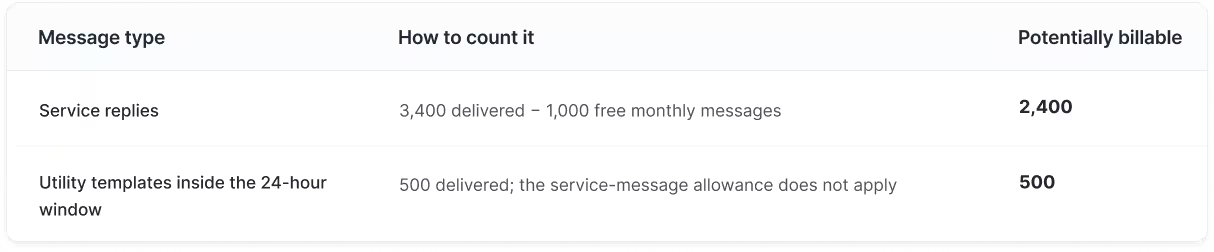
That is 2,900 potentially billable messages, but it is not one flat rate. To estimate the Meta charge, multiply the service and utility counts by their applicable rates, then add any other charged templates:
Estimated Meta charge = (billable service messages × service rate) + (utility templates × utility rate) + other charged messages
If you message customers in Thailand, Malaysia, and Singapore, calculate each destination market separately. Then add any provider fees shown on your invoice. Remember that 3,400 replies does not mean 3,400 customers: a single customer may receive several messages, and each delivered message affects the count. The 1,000-message allowance applies per business phone number per month, not per customer or conversation.
What still stays free?
Meta's 72-hour free entry point applies when an eligible customer starts a conversation through a Click-to-WhatsApp ad or the WhatsApp button on a Facebook Page and the business responds within Meta's required window. Eligible business messages during that free entry period are not charged. A regular organic WhatsApp enquiry does not become free simply because your team replies quickly. Review the free entry point rule in Meta's documentation when setting up ads or automations.
Incoming customer messages themselves are not business-sent messages subject to this per-message charge. The reported monthly service allowance is separate from the free entry point and does not make utility templates free.
Four steps to prepare without making support worse
- Measure delivered replies, not only conversations. Review at least one typical month of service messages, in-window utility templates and ad-generated conversations by phone number and customer market. A high chat count with one useful reply per customer has a different cost profile from a flow sending six short messages per question.
- Make each reply useful. Give the customer the information they asked for in a clear message. Avoid repetitive greeting, status and follow-up bubbles that add little value. Keep answers readable; squeezing everything into an unwieldy message can hurt the customer experience.
- Review automations and templates. Check whether an order update is sent twice, whether a bot sends several fragments where one answer would do, and whether a utility template is being sent unnecessarily during an open window. Follow Meta's template and opt-in requirements.
- Check the complete bill. Compare Meta's market-specific charges with your provider invoice and ask how platform fees, any additional message fees, currency conversion or taxes are shown. Budget against your actual message mix, not an average “cost per chat.”
Reduce repetitive replies with Zaapi
Zaapi brings WhatsApp and other customer channels into one shared inbox, with AI Agents, automations and analytics. That gives teams a way to see recurring questions, answer routine enquiries consistently and pass more complex cases to a person with the conversation in view. You can then review which workflows generate extra messages and improve them without slowing down support. Explore Zaapi.
Zaapi does not remove Meta's WhatsApp delivery charges. The goal is to make each reply timely and useful, while keeping the volume and cost of messages visible.
Frequently asked questions
Will the October 2026 pricing change affect everyone using WhatsApp Business?
No. These changes concern messages sent through the WhatsApp Business Platform (API). They do not mean that every message sent from the WhatsApp Business mobile app will be charged at API rates. If your business uses the API through a customer support platform, review your outgoing message volume and pricing.
Are WhatsApp replies within the 24-hour customer service window still free?
Not always from October 1, 2026. When a customer messages your business, the 24-hour window lets you send free-form replies. Under the new pricing, each business phone number gets 1,000 free service messages per month; additional delivered service replies are chargeable. Utility templates sent within the window also become chargeable. The window still determines when you can send a free-form reply, but it will no longer guarantee that the reply is free.
Are the first 1,000 WhatsApp conversations free?
No. The monthly allowance covers 1,000 service messages per business phone number, not 1,000 conversations or customers. For example, if one number delivers 1,200 service replies in a month, 200 exceed the allowance and may be billed. Utility templates have a separate pricing rule and do not use this service-message allowance. Check Meta’s rate card for the applicable destination-market rate.
Do replies from an AI Agent count as service messages?
Yes, if a third-party AI Agent sends a free-form reply through the WhatsApp Business Platform during the customer service window. For pricing purposes, that outgoing reply follows the service-message rules, just like a reply typed by your team. Meta Business Agent is a separate product with its own pricing model; its charges should not be confused with the WhatsApp delivery charges for a third-party AI Agent.
Does replying quickly make WhatsApp messages free?
Only when the conversation qualifies for a free entry point. If a customer starts a chat through an eligible Click-to-WhatsApp ad or Facebook Page WhatsApp button, responding within the required period can open a 72-hour window in which eligible business messages are free to deliver. Replying quickly to a regular customer enquiry is still good service, but speed alone does not remove the new service-message charges once your free monthly allowance is used.
Source and update note: Based on Meta's October 2026 developer pricing update, Meta's platform pricing and rate cards, WhatsApp's public pricing overview and Zaapi's product information. Checked 21 September 2026. Confirm the final allowance and market rates before publishing or budgeting.
